
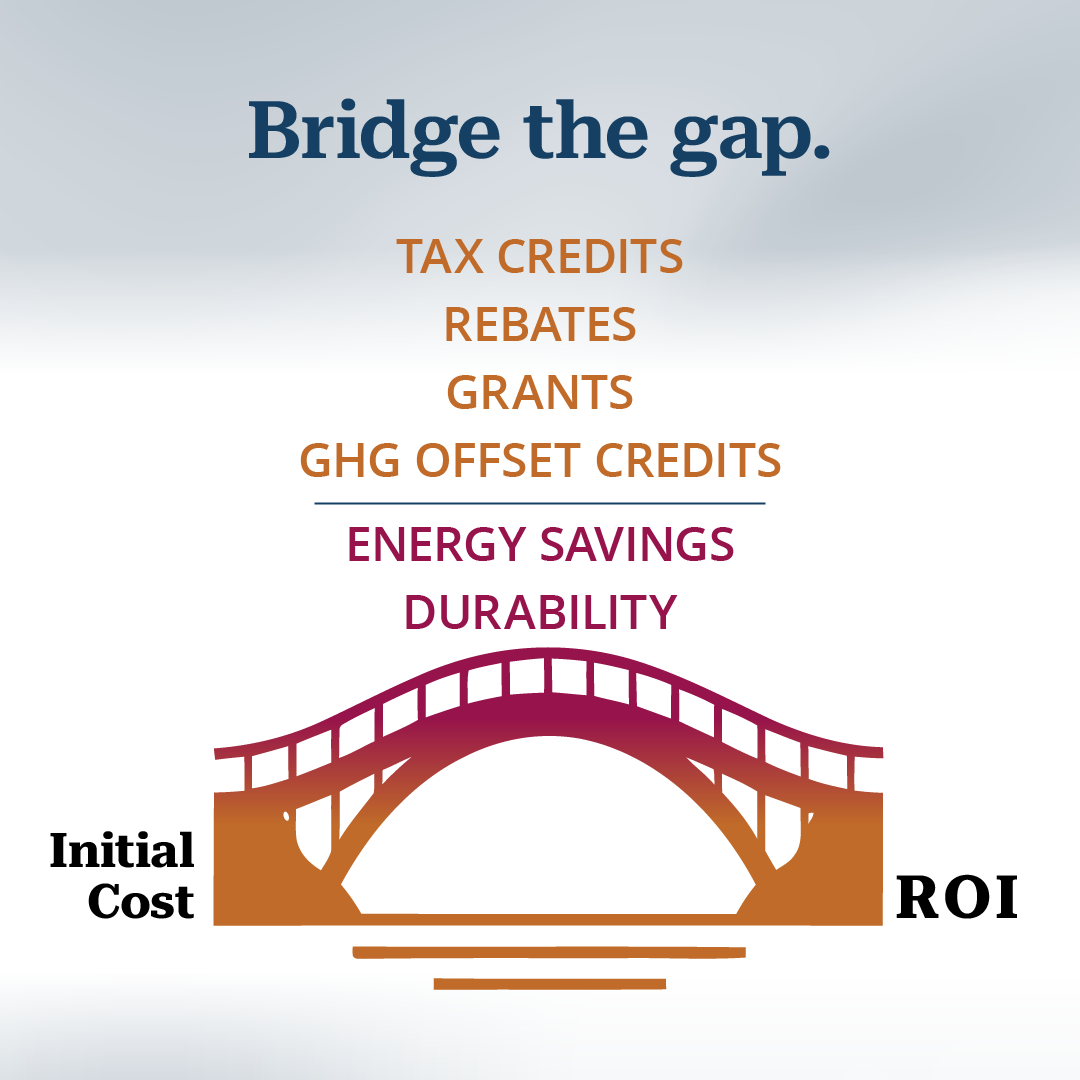
Investing in R744 (CO2) refrigeration, heat pump, or chiller technology can deliver substantial long-term savings through lower energy consumption, reduced maintenance, improved reliability, reduced greenhouse gas emissions, and protection against future regulatory bans or phasedowns. But initial system costs can spur organizations to delay adopting R744 or other natural refrigerants.
What's sometimes overlooked is that governments, utilities, and other entities across Canada and the United States offer various financial incentives that can offset equipment costs or improve your return on investment.
Depending on your particular project, location, and equipment needs, available support may include:
Federal tax credits
Utility rebates
State-level grants
Low-interest financing
Greenhouse gas offset credits
Many programs are refrigerant-neutral, rewarding improved energy efficiency or emissions reductions regardless of refrigerant choice. Others specifically encourage the adoption of natural refrigerants to replace super-polluting HFC systems.
Successful commercial, industrial, and institutional projects often combine multiple incentives. When permitted, stacking programs can significantly shorten payback periods.
Below are some of the most significant opportunities that might be available to you.
NOTE: Because rules can change and some programs may be paused, expire, or have limited application windows, it's smart to verify all details about available incentives directly from each source, as early as possible, during your project planning.
Federal Incentives in Canada
Clean Technology Investment Tax Credit (ITC)
Air-source and ground-source heat pumps are among the eligible technologies for Canada's Clean Technology ITC. The program, administered by the Canada Revenue Agency, provides a refundable tax credit of up to 30% of the capital cost of eligible clean technology equipment acquired before December 31, 2034. Organizations that choose not to meet prevailing labour requirements may qualify for a reduced 20% credit.
Green Municipal Fund (GMF)
Administered by the Federation of Canadian Municipalities, the GMF awards grants and loans to qualifying towns and cities to support the implementation of decarbonization projects. The funding covers 50–80% of eligible project costs, making large-scale sustainable infrastructure projects more affordable, such as district energy systems that incorporate environmentally responsible heat pumps.
Local, Provincial, and Utility Incentives Across Canada
Beyond the federal level, financial incentives can also be accessed through Canadian energy utilities or other local or provincial entities.
Many utilities offer rebate programs for measures aimed at improving energy efficiency. Although most rebates are intended for residential or small-commercial ratepayers, it is also possible to find rebates for commercial or industrial projects. Keep in mind that specific rebate programs often have limited funding windows, and some programs don't get renewed after they expire.
However, even if a utility doesn't explicitly list a rebate program for your intended purpose, it can sometimes pay to reach out and ask if they have a custom program. Some utilities are happy to create custom incentives for organizations planning to substantially reduce their energy consumption by using high-efficiency chillers, heat pumps, refrigeration packages, or other climate-friendly heating and cooling equipment.
Here are some examples.
British Columbia
BC Hydro offers custom project incentives for efficient electrification or energy efficiency improvements in large commercial or industrial facilities. Funding can cover up to 100% of capital costs, depending on your project's energy-saving potential.
The utility also offers capital funding support for low-carbon district energy systems.
Manitoba
Through Efficiency Manitoba, businesses can access rebates for air-source heat pumps and ground-source heat pumps. Commercial and industrial operators can also access custom performance-based financial incentives for other types of equipment that save energy, such as efficient refrigeration or waste heat recovery systems. Eligible projects include new facilities, renovations, and expansions.
Additionally, the Climate and Economy Solutions Program (CESP) awards joint federal-provincial grants to help organizations fund retrofit projects for the purpose of fuel-switching stationary equipment that relies on fossil fuels to equipment that uses renewable energy sources or improves energy efficiency, such as geothermal or air-source heat pumps.
Ontario
The Independent Electricity System Operator offers energy-efficiency programs that are supported by the Government of Ontario under the Save on Energy banner. For commercial, industrial, and institutional organizations (i.e., non-residential), two Save on Energy programs offer incentives for equipment upgrades:
The XLerate Program offers up to 75% of eligible project costs (up to $15 million) in the form of pay-for-performance incentives (i.e., $300 per MWh saved), with a minimum of 600 MWh needing to be saved as a result of your project each year. Several types of capital equipment costs can be eligible, including industrial heat pumps and systems for waste heat recovery.
The Retrofit Program offers up to 50% of eligible project costs for energy-efficiency upgrades, such as more sustainable chillers and heat pumps, that provide verifiable reductions in electricity consumption.
In addition, the City of Toronto offers low-interest Energy Retrofit Loans that can finance up to 100% of capital improvements, such as heat pumps or energy-efficient chillers, that help your business or institution decarbonize.
Québec
Through the province's EcoPerformance programs, commercial, industrial, and institutional organizations can receive up to 75% of eligible expenses for projects that reduce greenhouse gas (GHG) emissions, such as:
Up to $5 million per project (and up to $10 million per site per year) for replacing fossil fuels or improving processes, such as refrigeration, that generate fugitive GHG emissions. Of special note, only R744 is permitted as a refrigerant replacement under this program.
Up to $40 million per application (or $80 million per site) for implementing fugitive GHG reduction measures that go beyond existing standards in large industrial projects if you invest at least $15 million toward the effort and are part of the cap-and-trade system for emission allowances (SPEDE). Again, R744 is the only acceptable refrigerant replacement.
Up to $100,000 per structure for electrifying the heating in greenhouses, such as with heat pumps.
Financial support for waste heat recovery projects and the associated equipment, such as heat pumps used in thermal energy networks that connect buildings.
New Brunswick
Through NB Power's Business Rebate Program, you can get 25% back on the purchase of equipment that reduces your facility's GHG emissions and energy consumption.
Federal Incentives in the United States
Inflation Reduction Act (IRA)
Although the One, Big, Beautiful Bill Act (OBBB) eliminated many of the IRA's federal tax credits aimed at energy efficiency and decarbonization measures, it left one important area intact: tax credits for geothermal systems, including ground-source heat pumps. The base rate is 6%. But if you satisfy the prevailing wage and apprenticeship requirements, you could qualify for a federal tax credit up to 30% for eligible geothermal heating equipment.
State and Utility Incentives Across the U.S.
Local, utility, and state-level incentives for energy efficiency, GHG emission reductions, and refrigerant replacement vary greatly in the U.S., and not all jurisdictions have programs for commercial and industrial organizations.
However, it's still a good idea to inquire about possible custom incentives through your local utilities and stay abreast of what's happening in your state and municipality. Third-party organizations like VEIC can also help you find and take advantage of available incentives.
In addition, your state might be part of the United States Climate Alliance, a bipartisan coalition of governors aimed at doing their part to limit global warming to 1.5°C by 2100 (i.e., the main goal of the Paris Agreement). As of August 2026, 23 states are part of the U.S. Climate Alliance, including Arizona, California, Colorado, Connecticut, Delaware, Hawaii, Illinois, Maine, Maryland, Massachusetts, Michigan, Minnesota, New Jersey, New Mexico, New York, North Carolina, Oregon, Pennsylvania, Rhode Island, Vermont, Virginia, Washington, and Wisconsin.
As new climate-friendly policies are adopted in those states, we may start seeing more incentives to support commercial and industrial decarbonization.
In the meantime, here are some of the most notable incentive programs that currently exist.
California
The F-Gas Reduction Incentive Program (FRIP) awards funds to help organizations replace super-polluting HFC refrigeration equipment with systems that use refrigerants with ultra-low global warming potential (GWP), primarily natural refrigerants. This program has helped many food retailers (e.g., grocery stores and supermarkets) and cold storage operators throughout the state. However, it runs intermittently through yearly application windows. Stay informed about the next round by following the California Air Resources Board (CARB) or the third-party administrator of the program, the North American Sustainable Refrigeration Council (NASRC).
The Food Production Investment Program (FPIP) is geared toward helping food and beverage manufacturers reduce their GHG emissions through the adoption of decarbonization technologies like industrial heat pumps. Qualifying organizations, including cold storage operations, can receive up to $2,500,000 for eligible equipment. This program, from the California Energy Commission, also runs via intermittent rounds of funding opportunities.
New York
The Natural Refrigerant Demonstration Program from the New York State Department of Environmental Conservation (NYSDEC) helps food retailers in disadvantaged communities adopt natural refrigerants as part of full or partial retrofits in existing grocery stores. This pilot initiative is facilitated by the NASRC.
The New York State Energy Research and Development Authority (NYSERDA) offers a wide variety of programs to support decarbonization efforts, including access to funding opportunities for commercial properties, high-rise buildings, hospitals, and college and university campuses.
For low-interest financing, you can turn to a green lender like New York City Energy Efficiency Corporation (NYCEEC). Commercial, industrial, and institutional organizations can pursue loans for energy-efficient infrastructure or decarbonization projects that may have trouble attracting capital from other sources. Plus, New York isn't NYCEEC's only lending territory. They also award loans to organizations in Massachusetts, Rhode Island, Connecticut, New Jersey, Delaware, Maryland, Washington, D.C., and Pennsylvania.
Washington
For owners of large buildings who demonstrate early compliance with the state's Clean Buildings Performance Standard (CBPS), the Washington State Department of Commerce offers two tiers of financial incentives, depending on the type and size of building.
Oregon
Industrial organizations can qualify for cash incentives from Energy Trust of Oregon for custom projects that deliver lower energy consumption. The financial support can help offset the capital cost of equipment like energy-efficient industrial heat pumps, chillers, or refrigeration solutions.
Hawaii
Business rebates are available through Hawaii Energy for eligible custom projects to help offset the costs of energy-efficient commercial or industrial equipment.
Greenhouse Gas Offset Credits
You can earn tradeable credits by choosing chillers, heat pumps, and refrigeration solutions that use natural refrigerants. Every tonne of CO2-equivalent emissions you avoid can generate GHG offset credits you can monetize, turning your capital investment into a new revenue stream.
In Canada, the federal government's carbon offset program rewards businesses that reduce greenhouse gas emissions from refrigeration by switching to climate-friendly systems with low global warming potential (GWP). If you transition from high-GWP synthetic refrigerants like HFCs to low-impact options such as R744, you could qualify for offset credits under the Reducing Greenhouse Gas Emissions from Refrigeration Systems (RGGERS) protocol.
Organizations in the U.S. and Canada related to the food supply chain (e.g., grocers and cold storage operators) can also work with Therm to access funding opportunities for natural refrigerants adoption via GHG offset credits.