

Benefits of Natural Refrigerants
Proven Solutions for Long-Term Viability
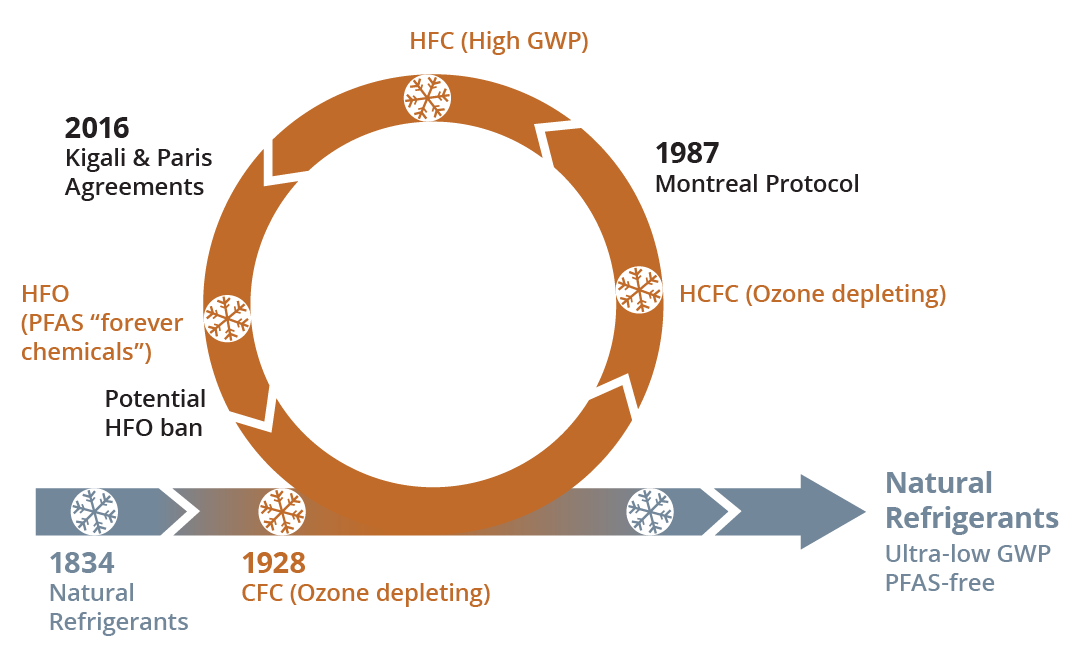
Refrigerant choices made today have a direct bearing on whether human health, the environment, and your capital investments are protected for tomorrow.
The differences between natural refrigerants and F-gas refrigerants (aka fluorinated or synthetic refrigerants) are stark, leading a growing number of organizations to reconsider their path forward when choosing new cooling and heating systems.
Natural refrigerants—such as CO2, ammonia, and hydrocarbons like propane and isobutane—offer:
Zero or ultra-low global warming potential (GWP)
Zero ozone depletion potential (ODP)
No PFAS pollution
No phasedowns
High-efficiency solutions for most applications
More heat recovery opportunities
Better performance and lower total cost of ownership in many situations
Table of Contents
The Ever-Increasing Problems With F-Gas Refrigerants
Refrigerant leaks are invisible, so few people think about them. But when you consider that large commercial and industrial refrigeration systems are especially prone to refrigerant leakage—as much as 25–30% of their charge annually in the case of supermarket systems—the potential impact becomes obvious.
That impact grows even larger if refrigerants are irresponsibly vented to the atmosphere during system maintenance or at the end of system life due to improper recovery or equipment decommissioning.
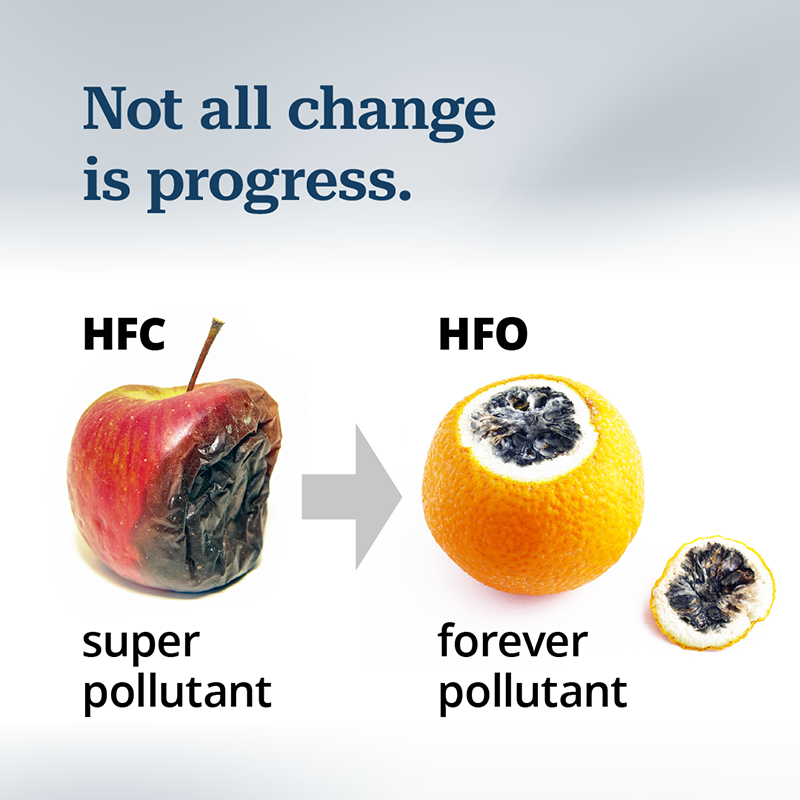
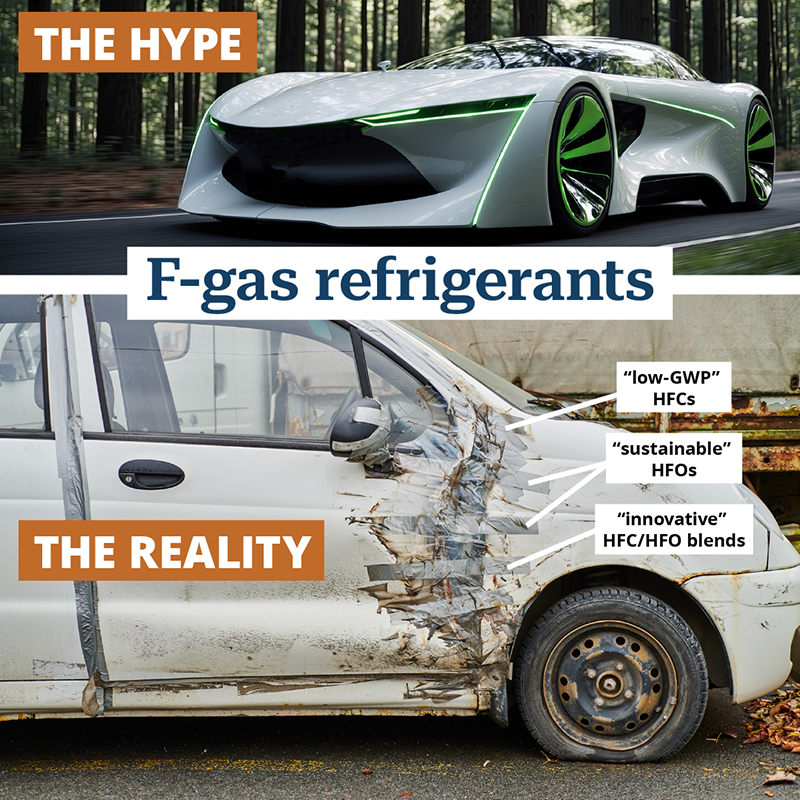
For decades, fluorinated refrigerants have been developed, redeveloped, patented, blended, and replaced in response to discoveries and regulations related to their environmental harms.
When today's F-gas refrigerants enter the atmosphere, they act as super-pollutants (contributing to global warming) and/or forever-pollutants (contributing to PFAS contamination when their degradation products fall back to earth).
Prior to the adoption of the Montreal Protocol in 1987 to phase out chlorofluorocarbons (CFCs) and hydrochlorofluorocarbons (HCFCs), ozone depletion was identified as the major problem with F-gas refrigerants. Those were replaced with hydrofluorocarbons (HFCs), which are now being phased down due to their high global warming potential after the Kigali Amendment to the Montreal Protocol was adopted in 2016.
Hydrofluoroolefins (HFOs), the newest generation of fluorinated refrigerants, have brought yet another environmental problem to light, leading some scientists to recommend bans on their use.
TFA, the "Forever Chemical" Hazard Posed by Many HFCs, HFOs, and A2Ls
Trifluoroacetic acid (TFA) is a type of PFAS (per- and polyfluoroalkyl substances) that is accumulating globally in groundwater and soil, even in remote Arctic regions. High levels of TFA also continue to be detected in human blood as well as food products like grain, wine, and beer.
Atmospheric deposition of TFA has more than tripled since 2000. Scientists have traced this rise clearly to the breakdown of fluorinated refrigerants (including HFCs and HFOs) used in modern HVAC-R and mobile A/C systems. Additional sources of TFA pollution come from fluorinated pesticides used in agriculture.
Although TFA has not been as well-studied as other PFAS, existing studies show that it can harm reproduction and liver health in mammals and be toxic to aquatic life. The Risk Assessment Committee (RAC) of the European Chemical Agency (ECHA) recommended that TFA be classified as toxic to human reproduction. And in human-relevant tests, Italian researchers found that TFA may reduce the production of antibodies.
Some scientists have argued that TFA pollution represents a planetary boundary threat due to its persistence, global spread, irreversibility, and disruptive hazards. Traditional water treatment methods are ineffective at removing TFA or are prohibitively expensive.
The most widely used HFO, R-1234yf, breaks down fully into TFA and is a major component in new-generation A2L refrigerant blends—such as R-454A, R-454B, and R-454C—increasingly being adopted as replacements for high-GWP HFCs.
TFA concentrations are already exceeding safe levels in some areas, and they're projected to increase dramatically in the coming years due to the expanded use of HFOs in cooling and heating systems.
High-GWP F-Gas Refrigerants, Pretending to Be Low-GWP
Carbon dioxide, used as the baseline reference for measuring the radiative efficiency (i.e., the "greenhouse strength") of compounds, has a global warming potential (GWP) of 1 across all time horizons. Most F-gas refrigerants have a GWP hundreds or thousands of times higher, making them super-pollutants.
For context, it's important to understand that most GWP comparisons and government policies are still based on outdated 100-year GWP values from the Fourth Assessment Report (AR4) published by the International Panel on Climate Change (IPCC) in 2007. This is problematic for two reasons:
Climate science has evolved, resulting in updated GWP values in the most recent IPCC report, the Sixth Assessment Report (AR6).
Although 100-year GWP values are often used as the standard due to CO2's long life in the atmosphere, they distort the true near-term impacts of most F-gas refrigerants, which, like methane, are much shorter-lived. To reflect the actual potency of HFCs and HFOs during the time in the atmosphere in which their cumulative warming effects are most pronounced, 20-year GWP values are far more relevant.
Because of their large near-term effects on the climate, reducing the use of methane and F-gas refrigerants represents one of the most effective ways to slow global warming right now. It's an "emergency brake" opportunity that can help buy more time for other actions to take effect. Otherwise, we will keep producing the kinds of emissions that supercharge global warming and speed up the arrival of irreversible tipping points.
R-32, a common HFC refrigerant used alone and in many A2L blends, is a good example of how large the difference can be between 100-year and 20-year GWP values. According to IPCC AR6, the 100-year GWP of R-32 is 771; in IPCC AR4, it is 650. However, the 20-year GWP in IPCC AR6 for R-32 is 2,690—more than three times higher.
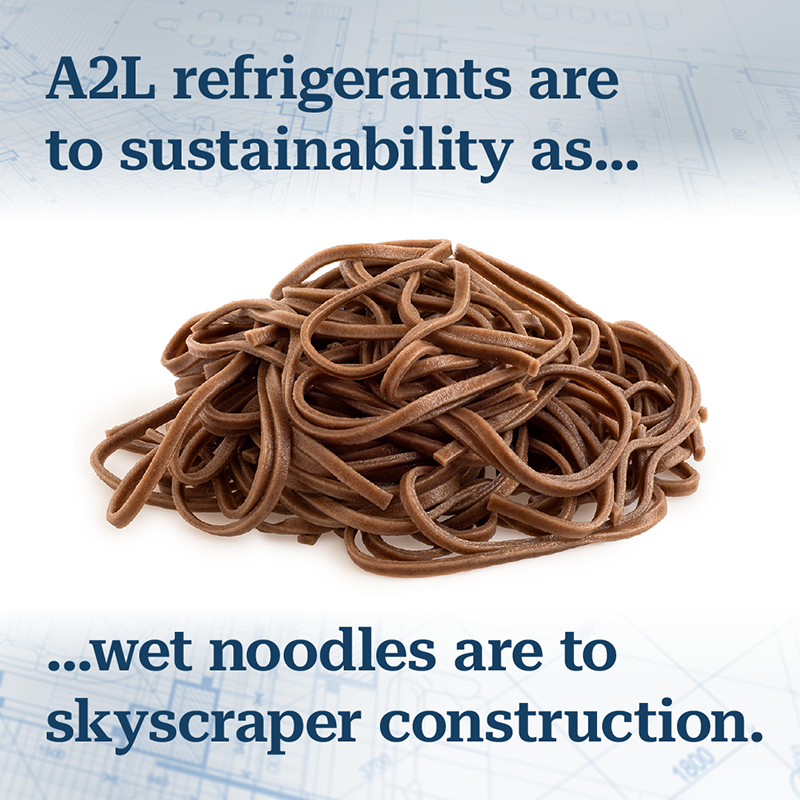
Yet many government regulations still consider R-32 a "low-GWP" refrigerant, despite its super-potency compared to CO2. That label provides the illusion of sustainability without any real environmental credibility. The same can be said of numerous other F-gas refrigerants, including so-called "low-GWP" A2L refrigerant blends that combine HFCs with HFOs.
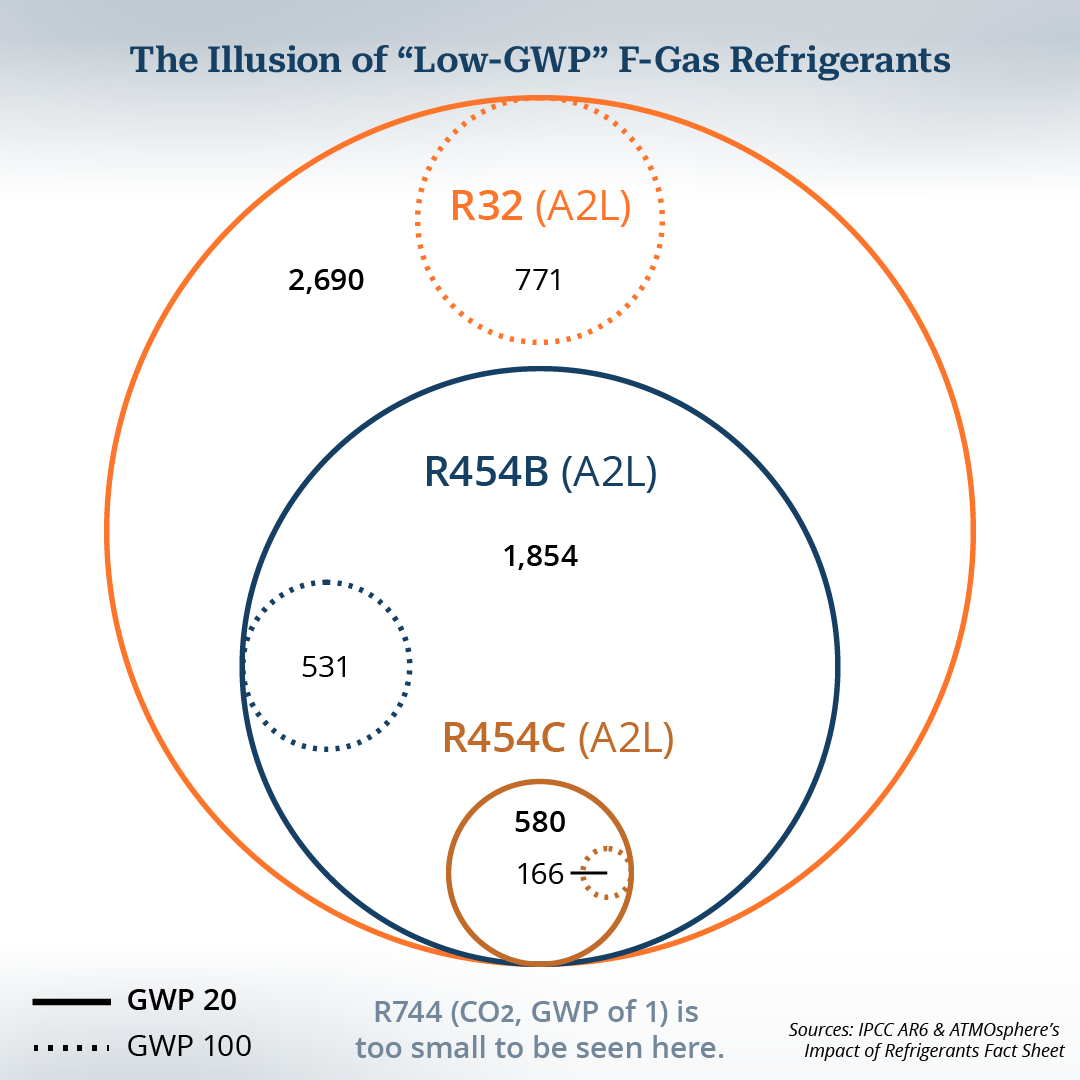

Here are 20-year GWP values of some of the most common F-gas refrigerants used before the Kigali Amendment (based on IPCC AR6 and ATMOsphere's Impact of Refrigerants Fact Sheet):
R-404A — 7,208
R-410A — 4,715
R-407C — 4,457
R-134a — 4,140
Here are 20-year GWP values of some of the F-gas refrigerants increasingly being used as replacements after adoption of the Kigali Amendment (based on the same sources):
R-448A — 3,321
R-32 — 2,690
R-454B — 1,854
R-513A — 1,823
R-450A — 1,742
R-152a — 591
R-454C — 580
R-1234yf — 1.81
Everything in the above list can be considered PFAS, with the exception of R-32, which still has a high GWP compared to CO2 and other natural refrigerants.
Plus, evidence suggests that, in addition to TFA, one of the atmospheric degradation products of "low-GWP" HFOs is HFC-23, a super-potent greenhouse gas with a 20-year GWP of 12,400 (according to IPCC AR6).
Upstream Emissions From the Production of F-Gas Refrigerants
Fluorinated gases are made only by humans and do not occur in nature.
F-gas manufacturers have consistently hidden the full lifecycle emissions of the refrigerants they produce by shielding upstream production data behind patents, lax monitoring, and proprietary processes.
But one thing is for sure: Fugitive emissions of chemical feedstocks, including high-GWP and ozone-depleting substances, during the production of HFCs and HFOs further contribute to their climate impact.
For instance, carbon tetrachloride, deemed a probable carcinogen by the U.S. EPA, is a chemical feedstock used in the production of HFOs. Carbon tetrachloride has a 20-year GWP of 3,810 (according to IPCC AR6) and is a highly potent ozone-depleting substance.
According to a review by the Environmental Coalition on Standards (ECOS) of the limited independent studies available on this subject, the carbon footprints of fluorinated refrigerants during the manufacturing phase are much higher than those of non-fluorinated natural refrigerants.
For example, for F-gas refrigerants, it lists the following estimated ranges for their manufacturing-related carbon footprints (measured as CO2-equivalent emissions per kilogram of refrigerant produced):
R-134a (HFC) = 10–87 kg CO2e/kg
R-32 (HFC) = 86–295 kg CO2e/kg
R-22 (HCFC) = 205–393 kg CO2e/kg
For R-1234yf (an HFO), the ECOS review states that one industry-funded study estimated a manufacturing carbon footprint of 10.9 kg CO2e/kg. But there are reasons to think the true carbon footprint could be as high as 205–393 kg CO2e/kg.
Compare that to the estimated ranges for these natural refrigerants:
R-744 (CO2) = 0.7–2.5 kg CO2e/kg
R-290 (propane) = 0.9–2.5 kg CO2e/kg
R-717 (ammonia) = 2–2.5 kg CO2e/kg
Regulatory Uncertainty & Rising F-Gas Costs
When it comes to HFCs, the overall trajectory is clear. A phasedown is happening.
In the U.S., the HFC phasedown is governed by the American Innovation and Manufacturing (AIM) Act. In Canada, it is governed by the Ozone-depleting Substances and Halocarbon Alternatives Regulations (ODSHAR). The phasedown schedule in both countries mirrors what is in the Kigali Amendment. By 2036, the production and consumption of HFCs is to be reduced by 85% from baseline 2011–2013 levels, with key reduction milestones along the way.
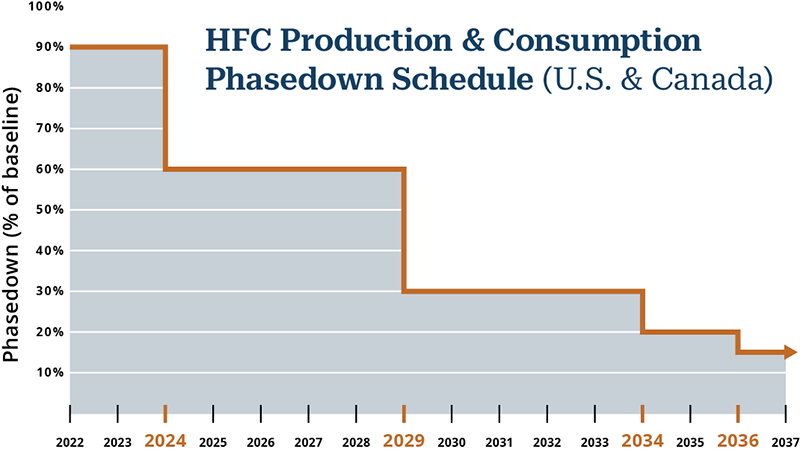
Where things can get murky is in the implementation and enforcement of this phasedown, particularly in the U.S.
For example, the U.S. Environmental Protection Agency (EPA), responsible for implementing the AIM Act, is subject to the political whims of each new presidential administration. So timelines can shift and other regulatory measures can change, such as with the EPA's Technology Transitions Rule.
At the same time, some states have enacted measures that are more restrictive than the AIM Act, such as when it comes to GWP limits for refrigerants used in various types of residential, commercial, and industrial equipment. State-level regulations are also subject to political pressures, which means the rules can change unexpectedly.
Because of the global HFC phasedown, the F-gas refrigerant market is prone to significant unpredictability and upward pricing pressure. In Europe, which is ahead of North America in its HFC phasedown timing, the prices of some fluorinated refrigerants have risen as much as 1,000% or more since the EU F-gas Regulation took effect.
Plus, even as the shrinking supply of older HFCs causes price spikes, newer HFO-based refrigerants are subject to their own pricing pressures. Due to patent restrictions, research expenses, and limited production capacity, HFOs and A2L HFC/HFO blends typically carry much higher price points than natural refrigerants.
And because most of them break down into TFA, HFOs and A2Ls may become subject to new PFAS-related bans or phasedowns in the coming years.
So what feels "compliant enough" today can become a big liability tomorrow.
Mounting environmental scrutiny is already here, with more regulatory pressures on the horizon, which could lead to underperforming investments and stranded assets for those who choose the F-gas path.
Natural Refrigerants: The Path of Clarity
We don't need more temporary replacements. The reasons to break from the failed F-gas paradigm have never been stronger.
Organizations can leapfrog the F-gas chaos and choose a stable paradigm based on sensible non-fluorinated refrigerants, each matched to their suitable use cases and safety requirements.
Proven, future-ready cooling and heating systems are available for many of the most demanding commercial and industrial applications. And natural refrigerant solutions frequently enable higher efficiencies and lower total cost of ownership.
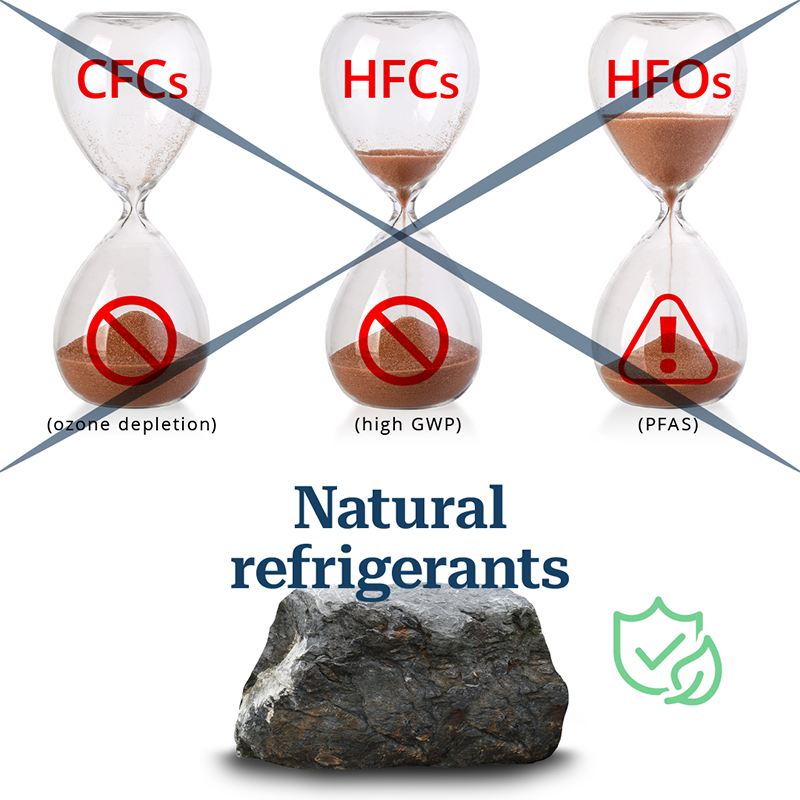
Natural refrigerants include compounds such as:
R-744 (carbon dioxide)
R-290 (propane)
R-717 (ammonia)
R-600a (isobutane)
R-1270 (propylene)
R-718 (water)
R-729 (air)
Natural refrigerants aren't without some initial tradeoffs, such as specialized training and safety considerations (not unlike mildly flammable A2Ls).
But if you have to put in the effort to transition to new refrigerants anyway, shouldn't you make it the last transition you'll ever need to make?
Real Environmental Credibility
Customers, investors, and communities increasingly expect organizations to minimize harms to human health and the environment. And people are more attuned than ever to any attempts at greenwashing irresponsible products and solutions.
That makes natural refrigerants useful for establishing true environmental leadership, building public trust, and helping organizations achieve ESG objectives or other sustainability commitments.

Although industrial processes are involved in bringing refrigerant-grade ammonia, CO2, propane, etc. to market, the term "natural refrigerants" is a useful identifier because these compounds already exist naturally in the biosphere.
Natural refrigerants have zero ozone depletion potential, do not contribute to TFA or other PFAS pollution, and have the lowest global warming potential of all refrigerants at values of 0 to 1.
For example, here are the 20-year GWP values of the most common natural refrigerants for commercial and industrial applications (based on IPCC AR6):
R-717 (ammonia) — 0
R-290 (propane) — 0.072
R-744 (CO2) — 1
Long-Term Viability

A durable cooling and heating strategy starts with identifying what could change next in terms of refrigerant-related regulations.
Future-proof natural refrigerants help shield you from the evolving environmental liabilities, reputational risks, supply chain uncertainties, and phasedown-related compliance burdens associated with F-gas refrigerants.
That means no worrying about premature equipment obsolescence, stranded assets, or unplanned retrofits when making capital investments intended to operate for 15 to 20 years.
High Efficiency for Almost Any Application
Natural refrigerants represent the gold standard for thermodynamic performance, often providing greater efficiency than F-gases, particularly in low- and medium-temperature applications.
Of course, the efficiency advantages depend on the specific natural refrigerant(s) involved, the particular application, the operating conditions, and the system design. Each natural refrigerant is best-suited for certain types of applications. And each one varies in its safety and infrastructure requirements.

Taken together, natural refrigerants enable the delivery of highly efficient and reliable solutions for a wide range of residential, commercial, and industrial cooling and heating applications across numerous industries.
To further maximize efficiencies, some modern systems employ multiple natural refrigerants in hybrid or cascade configurations. For example, ammonia/CO2 cascade systems are commonly used in industrial refrigeration to combine the high-stage efficiency of ammonia with the low-temperature performance of CO2.
R-744 (CO2)
R-744 has an A1 safety rating due to being non-flammable and non-toxic (at typical concentrations). Its unique thermodynamic properties make it ideal for low-temperature applications, cold or mild climates, and heat recovery opportunities.
The highest efficiencies are achieved when operating in a subcritical cycle. But thanks to several technological advancements, transcritical CO2 systems in hot climates can also achieve efficiencies on par with other refrigerants.
Because R-744 systems operate at higher pressures, components and supporting infrastructure must be more durable than for other refrigerants. However, CO2's properties provide for space-efficient designs because systems tend to be more compact and the required piping is smaller.
Good applications for R-744 include:
Food retail refrigeration (supermarkets, grocery stores, etc.)
Process chilling (dairies, breweries, etc.)
Freezing (food manufacturing, etc.)
Simultaneous heating and cooling
Large-building HVAC
Recreational facility cooling and heating (ice rinks, swimming pools, etc.)
Data center cooling
Hot water production
Recovery of low-grade "waste heat"
R-717 (Ammonia)
Ammonia is well established in the industrial refrigeration space thanks to its excellent thermodynamic characteristics. Its B2L safety rating means it is a mildly flammable refrigerant and toxic to humans (but environmentally benign), so special safety precautions must be implemented and maintained. However, ammonia's pungent odor makes leaks easy to detect, and most installations have a good safety track record.
Common applications for R-717 include:
Large-scale cold storage
Industrial food and beverage processing
Process chilling
Freezing
Ice rinks
Centralized cooling for large buildings
Low-carbon district energy systems
Data center cooling
Recovery of low-grade "waste heat"
Hydrocarbons (Propane, Isobutane, Etc.)
Hydrocarbons such as R-290 (propane) and R-600a (isobutane) are mostly used in small-scale residential and light-commercial applications. This is mostly due to their A3 safety rating, meaning they are highly flammable and thus require appropriate system designs and safety measures. However, because they are also extremely efficient, hydrocarbon refrigerants are used in much smaller quantities inside systems, with around half the charge required compared to similar systems that use F-gases.
In the future, as hydrocarbons gain regulatory approval in more jurisdictions and building codes are updated, they may be used in larger applications. Hydrocarbon refrigerants are especially suited for systems in hot climates.
Common applications for R-290 and R-600a include:
Household refrigerators
Light-commercial refrigeration units (grocery display cases, etc.)
Process chilling
Heating and air conditioning
Hot water or steam production
Ultra-low-temperature applications below -40°C (-40°F)
Water and Air
R-718 (water) and R-729 (air) are still being researched and developed as refrigerants, primarily for niche applications. For example, water can be used in above-freezing cooling applications, and air can be used in ultra-low-temperature cooling processes below -51°C (-60°F).
Long-Term Economic Advantages
The lowest-cost solution at the purchase stage is not always the lowest-cost solution over the full lifespan of a cooling or heating asset.
Due to the need for more robust components or special safety features, systems that use natural refrigerants have often required a larger upfront investment. However, with the move from high-GWP HFCs to mildly flammable A2L F-gas systems that require their own additional safety measures, equipment and installation costs are starting to even out. In some cases, natural refrigerant systems are now less expensive than comparable A2L systems.
Regardless, natural refrigerant systems typically achieve a total cost of ownership at least on par with F-gas systems—and often lower. Increasingly, organizations can expect better long-term ROI when choosing natural refrigerants due to factors such as:
Long-term energy savings from higher efficiencies
Long-term price stability (and relative inexpensiveness) of refrigerant recharges
Protection against GWP- and PFAS-related regulatory phasedowns or bans and the unplanned retrofits that could result
Financial incentives that support the adoption of natural refrigerants or technologies for decarbonization and energy efficiency, such as greenhouse gas offset programs, tax credits, grants, or rebates; for example:
Canada's Clean Technology Investment Tax Credit (ITC), which can help offset the cost of new commercial or industrial air-source or ground-source heat pumps, including those that use natural refrigerants.
Canada's federal offset credits program, Reducing Greenhouse Gas Emissions from Refrigeration Systems (RGGERS), which can help businesses monetize their switch to systems that use climate-friendly refrigerants.
California's intermittent F-Gas Reduction Incentive Program (FRIP), which helps supermarkets and cold storage operators fund the replacement of HFC refrigeration equipment with ultra-low-GWP natural refrigerant systems. (Watch for the next application window.)
New York's Natural Refrigerant Demonstration Program, helping grocery retailers in disadvantaged communities fund store retrofits for the adoption of natural refrigerants
By opting for natural refrigerants, organizations can secure more predictable costs and shield themselves from the volatility, regulatory uncertainty, and future liabilities associated with F-gases.
Ready to Make a Durable Transition?
Vitalis R-744 solutions help organizations build for resilience and longevity.