

Project Snapshot
End user: University of British Columbia – Okanagan Campus (UBCO)
Location: Kelowna, British Columbia, Canada
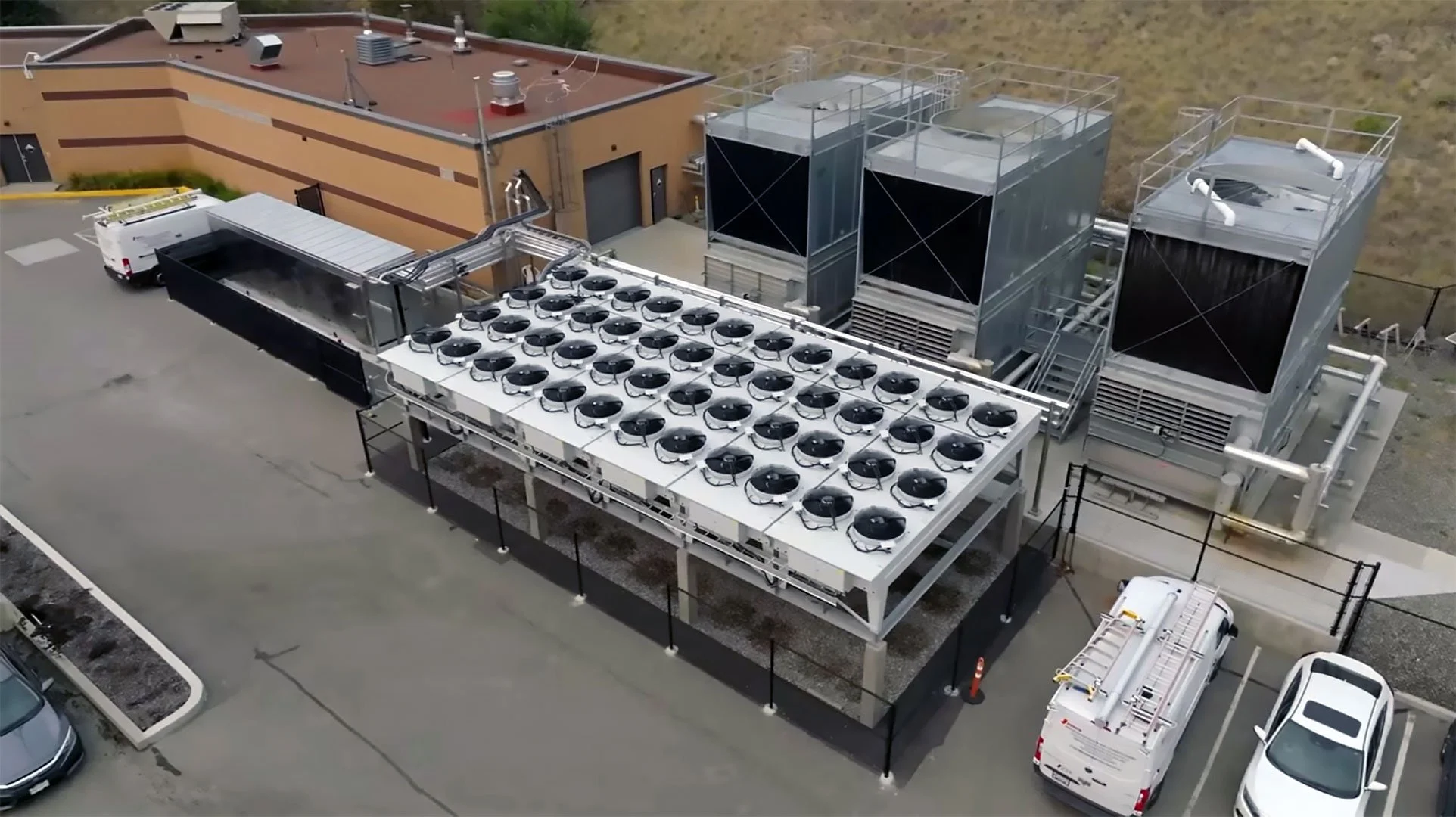
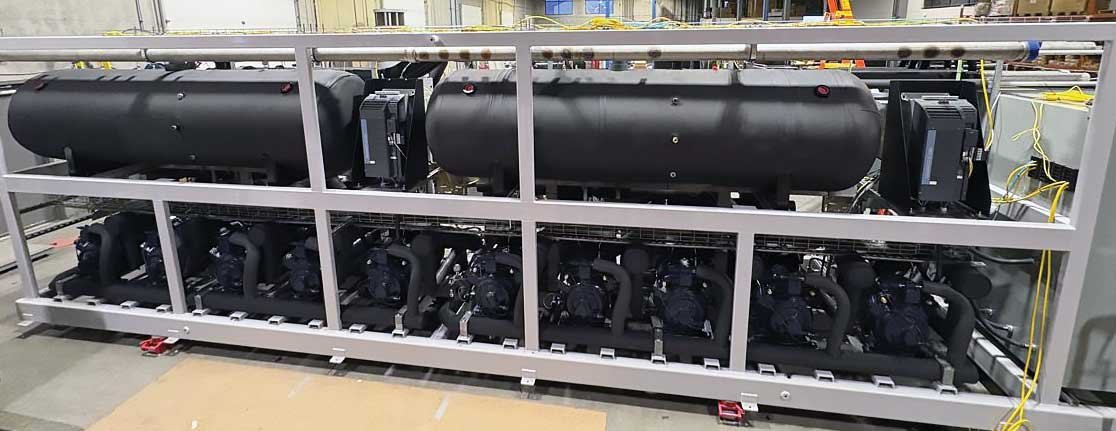
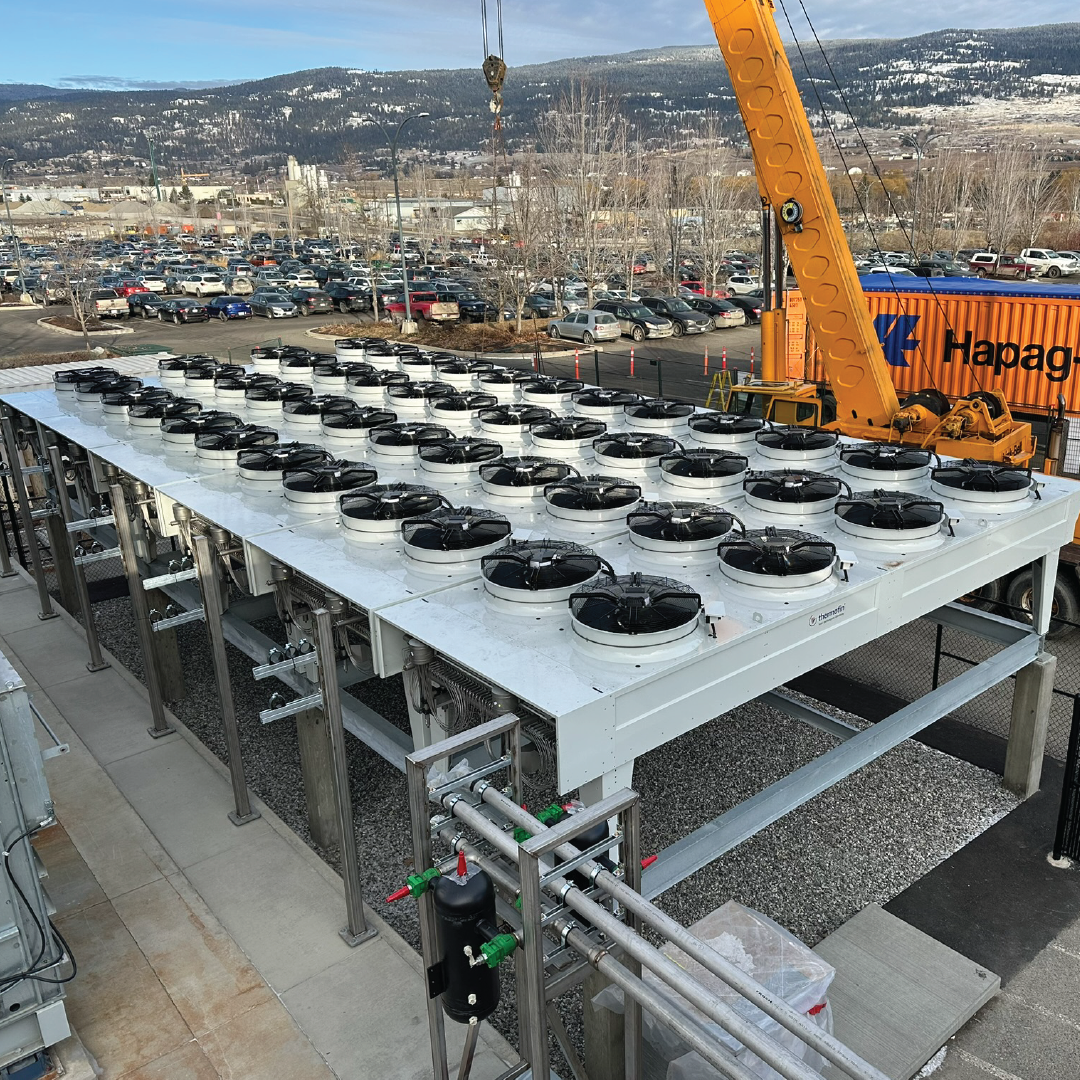
System: Vitalis Coolshift™ 1.5 MW reversible R744 (CO2) air-source heat pump (ASHP)—the largest known R744 ASHP deployed for a district energy system in North America. Features custom control architecture and two independent refrigeration circuits, each with five semi-hermetic compressors. Includes a total of six 300 kW flatbed air heat exchanger (AHX) units, three for each circuit, with each AHX unit sporting eight variable-speed fans.
Capacities: 1.5 MW nominal heating capacity at -10°C; approximately 1.5 MW cooling capacity at 30°C / 1.7 MW at 25°C
Operating temperatures: Reliable performance from -20°C to 40°C, conditioning an ambient low-temperature district energy system (LDES) operating between 8°C and 25°C
“The CO2 ASHP will be able to handle 98.8% of the current total heating load in one of our two district energy systems. This will displace gas boiler heating for base load and reduce GHG emissions by over 815 metric tons annually. The UBCO climate action plan has a target of reducing emissions by 65% by 2030 from our 2013 baseline. This project will achieve more than 50% of our GHG reduction targets and will accelerate our journey to our 2030 targets.”
— Colin Richardson, Associate Director of the Energy Team at UBCO
A Growing Campus With Ambitious Climate Targets
The challenge of achieving aggressive decarbonization goals can be daunting for any university, let alone a growing one. With an expanding campus and student population come expanding requirements for heating and cooling. Coupled with the need to keep operating costs under control and tuition affordable, many universities struggle to find actionable, enduring solutions.
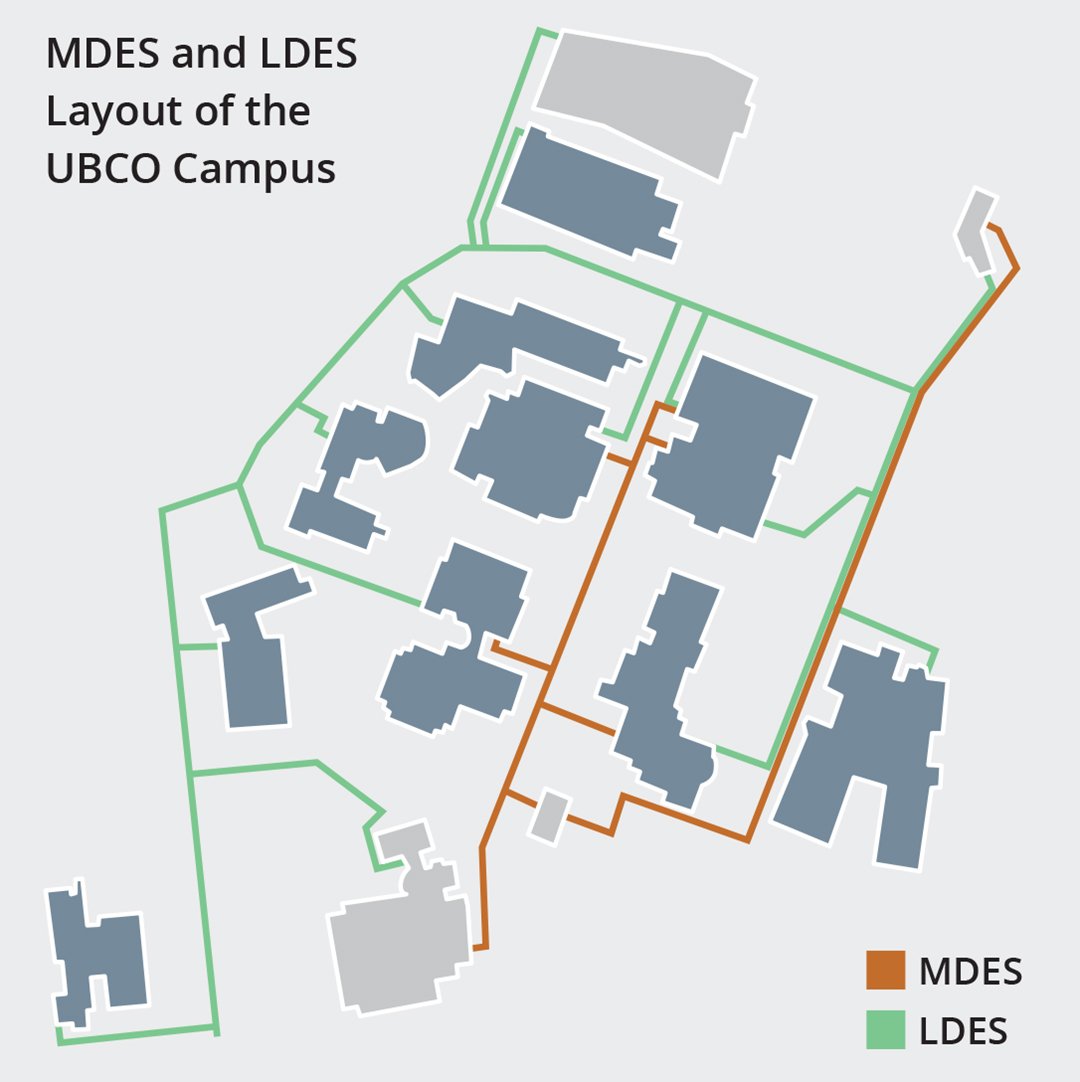
At the University of British Columbia – Okanagan Campus (UBCO) in Kelowna, part of the challenge lies in decarbonizing their existing thermal energy networks, which include a medium-temperature district energy system (MDES) connecting older buildings and an ambient low-temperature district energy system (LDES) connecting newer buildings.
District heating and cooling is nothing new, of course. In North America, the first networks for sharing thermal energy were created more than a century ago. With each new generation, thermal energy networks have become more flexible, reliable, and efficient.
Even so, many modern district energy systems still rely on gas boilers for significant portions of their annual heating loads, which means they're producing large quantities of greenhouse gas emissions every year—a big problem when you're trying to decarbonize.
For UBCO, the solution started with deploying a Vitalis Coolshift™ centralized air-source heat pump (ASHP). It utilizes R744 (CO2), an A1 natural refrigerant with ultra-low global warming potential (GWP) and no PFAS toxicity.
The Existing System: Over 14,000 GJ of Heating to Decarbonize
Before getting to the R744 ASHP, it's important to understand the existing setup.
Unlike the MDES, which supplies water at 80°C, the LDES at UBCO supplies ambient-temperature water between 8°C and 25°C. The water is distributed via underground, uninsulated PVC piping to individual hydronic heat pumps in each connected building, which either absorb heat from the LDES loop for heating or reject heat to the loop for cooling.
Infrequently, during shoulder seasons, these heat pumps can maintain the LDES loop temperature thanks to a balanced load (i.e., some buildings require heating while others require cooling). But most of the time, when the thermal load is unbalanced because of extra demand for either heating or cooling, the LDES taps into centralized systems that include natural gas boilers, a connection to the MDES, open-loop geothermal, and fluid coolers.
For a typical cold year, such as 2022, the total annual heating demand of the LDES loop is 14,267 GJ. Nearly 70 percent of that demand occurs with outdoor temperatures between -5°C and 5°C.
Prior to the Vitalis ASHP, natural gas boilers provided the vast majority of heating to the loop, followed by the connection to the MDES, which is also served by gas boilers. The open-loop geothermal system supplies the rest of the heat, though in smaller amounts.
For summer cooling, fluid coolers (i.e., wet cooling towers utilizing evaporative cooling) are the primary source of heat rejection from the LDES loop. They are highly efficient and augmented by occasional heat rejection into the geothermal system.
Like most district energy systems, the LDES has several advantages. For this thermal network, UBCO has cited benefits such as:
Minimal heat losses due to the ambient low-temperature distribution
Energy sharing between buildings for higher efficiency
The ability to provide both heating and cooling
Compatibility with diverse thermal energy resources
Centralized maintenance with reduced space requirements for mechanical equipment
The Challenge: Displace Gas Boilers With a Future-Proof Solution
As part of its climate action plan for campus operations, UBCO is targeting a 65-percent reduction of greenhouse gas (GHG) emissions from 2013 levels by 2030. This goal is extra challenging in light of plans to expand the campus.
Since natural gas boilers represent the largest source of GHG emissions for the LDES, UBCO knew that decarbonizing the thermal network would require replacing them—as much as possible—with technologies that don't burn fossil fuels.
Beyond GHG emission reductions, any decarbonization strategy must also include considerations for issues like capital and operating costs, scalability, and resiliency to known and potential regulatory changes.
That led UBCO to explore various potential solutions before arriving at centralized air-source heat pumps as the most appropriate technology for this particular application.
Heat pumps are popular solutions for high-efficiency electrification of heating and cooling loads. However, all heat pumps are not created equal. The type of refrigerant in a heat pump plays a crucial role, not just for performance, but also for sustainability.
Hydrofluorocarbons (HFCs) are the dominant refrigerants used today. But they are being phased down due to their high global warming potential (GWP), which can be hundreds or thousands of times greater than the GWP of carbon dioxide. That makes HFCs not just bad for our climate, but also increasingly expensive and harder to obtain.
So for UBCO, the challenge was to source economically viable, low-GWP ASHP technology that aligns with their decarbonization strategy.
The Solution: A 1.5 MW R744 Air-Source Heat Pump From Vitalis
For this type of application, at this scale, "off-the-shelf" solutions either don't exist or carry unwanted drawbacks. The solution had to be customized, which provided the opportunity to design a system with the best possible performance for the specific operating conditions.
Carbon dioxide (aka R744 when used as a refrigerant) offers several advantages over other refrigerants. For example, CO2:
Has a GWP of 1 (compared to 20-year GWP values up to 12,400 for HFCs)
Is an A1 refrigerant with no toxicity, no flammability, and no corrosiveness
Has zero ozone depletion potential
Is widely available and up to 12-20 times less expensive than synthetic refrigerants
Carries no risk of regulatory bans as a natural refrigerant
Does not contribute to environmental PFAS contamination, unlike hydrofluoroolefins (HFOs) and many HFCs

R744 is also well-suited to ambient low-temperature district energy applications. In heating mode—under subcritical operation—the performance of an R744 heat pump for an LDES like UBCO's can't be surpassed. No other refrigerant can match the efficiency.
That's the key. In the subcritical thermodynamic cycle, carbon dioxide remains below its critical threshold of 31°C and 1,073 psi. It doesn't reach the higher pressures and temperatures required of a transcritical cycle, in which the refrigerant moves between the subcritical phase and the supercritical phase (i.e., above the critical threshold).
Today, most R744 systems operate in a transcritical thermodynamic cycle. But for UBCO's LDES, the Vitalis Coolshift heat pump operates subcritically in heating mode.
The reversible air-source heat pump has a nominal capacity of 1.5 MW at -10°C and is designed to operate with outdoor temperatures between -20°C and 40°C. It will be the primary source of heat for the LDES, making the network much less reliant on natural gas.
During summer, the heat pump operates in a transcritical cycle, acting as an auxiliary source of cooling with the high-efficiency fluid coolers remaining as the primary source.
The 1.5 MW Vitalis Coolshift R744 ASHP design is unique in its ability to operate efficiently in both subcritical and transcritical modes, unlike conventional CO2 heat pumps that only operate in either subcritical or transcritical mode.
This project also includes an upgrade path for scalability capable of providing 2.5 MW of capacity.

Advanced Control Strategy
Off-the-shelf control systems are not sufficient for ASHPs at this scale and complexity. So a defining feature of this installation is the custom control architecture developed by Vitalis to optimize performance under part-load conditions, where the system operates for the majority of the year.
The control approach is based on pre-calculated operating maps and real-time system monitoring to dynamically adjust key operating parameters for continuous tuning and refinement over the operating season.
Pre-calculated operating maps: Control algorithms leverage pre-calculated optimal fan speeds as a function of ambient conditions and thermal heat output (based on the number of active compressors), along with coordinated pump speed control aligned with compressor staging.
Intelligent staging: The system dynamically switches between single- and dual-circuit operation depending on load demand. This enables efficient operation across a wide capacity range.
Predictive management: The system minimizes traditional feedback-only control loops. Instead, the system uses predictive and condition-based control to dynamically adjust variables such as fan speed, valve positions, and pump operation. This approach improves system stability and avoids performance degradation associated with transient disturbances, particularly under low-load or unstable operating conditions.
Optimized defrost: Rather than using fixed schedules, defrost cycles are optimized through a sensor-driven, algorithm-based approach and initiated based on actual system conditions. This reduces unnecessary defrost events and improves overall system efficiency.
Field data indicate that fan power consumption is a significant contributor to overall system performance, particularly during shoulder seasons when the system operates at reduced capacity. The implemented control strategy has demonstrated improved hourly efficiency, enhanced system responsiveness, and more stable operation across varying load conditions.
Collaboration With UBCO
This project has been defined by strong, continuous collaboration between Vitalis and UBCO. During the design phase, UBCO provided three years of hourly district heating and cooling load profiles. This data enabled a detailed understanding of demand distribution across varying ambient conditions and supported the development of control strategies to optimize operation. In particular, it allowed for informed decisions on when to operate single or dual circuits to maximize system coefficient of performance (COP).
The load profile data also supported quantification of the system's carbon reduction potential and enabled precise performance evaluation across operating conditions, including performance mapping for individual compressor operation at different ambient temperatures.
Following commissioning, the collaboration focused on optimizing real-world operation to ensure reliability and efficiency. This included refining operating strategies to better utilize the thermal inertia of the district water system, thereby reducing excessive cycling of heat pump circuits.
In addition, joint efforts were made to improve system performance data visualization on UBCO's online platform. This enabled ongoing performance tracking, facilitated troubleshooting, and supported continuous optimization of system operation.
Anticipated Outcomes
Based on an energy analysis by Vitalis, installing this ASHP was anticipated to result in:
815 tonnes of GHG emission reductions annually
The displacement of 430,000 cubic meters of natural gas annually
The annual delivery of 14,000 GJ of heating—98.4% of the LDES' total heating demand
The annual delivery of 99.9% of the required auxiliary cooling demand
An annual COP for heating of 3.5
An annual COP for cooling of 3.6
Preliminary Field Results
Preliminary field data and recent operational monitoring confirm that the system meets performance expectations, with some caveats. Over the 2025–2026 winter season, the ASHP was still being commissioned, which means this data is based on partial operation while Vitalis worked through some issues and fine-tuned the system.
Average winter COP: 3.2 (expected to improve with continuous refinements)
Total heating demand over the winter: 8,526 GJ (a relatively mild winter)
ASHP-delivered heat over the winter: 6,474 GJ
CO2e emissions reductions: 340 tonnes (could have been an additional ~100 tonnes will full operation)
Snapshot #1: February 16, 2026
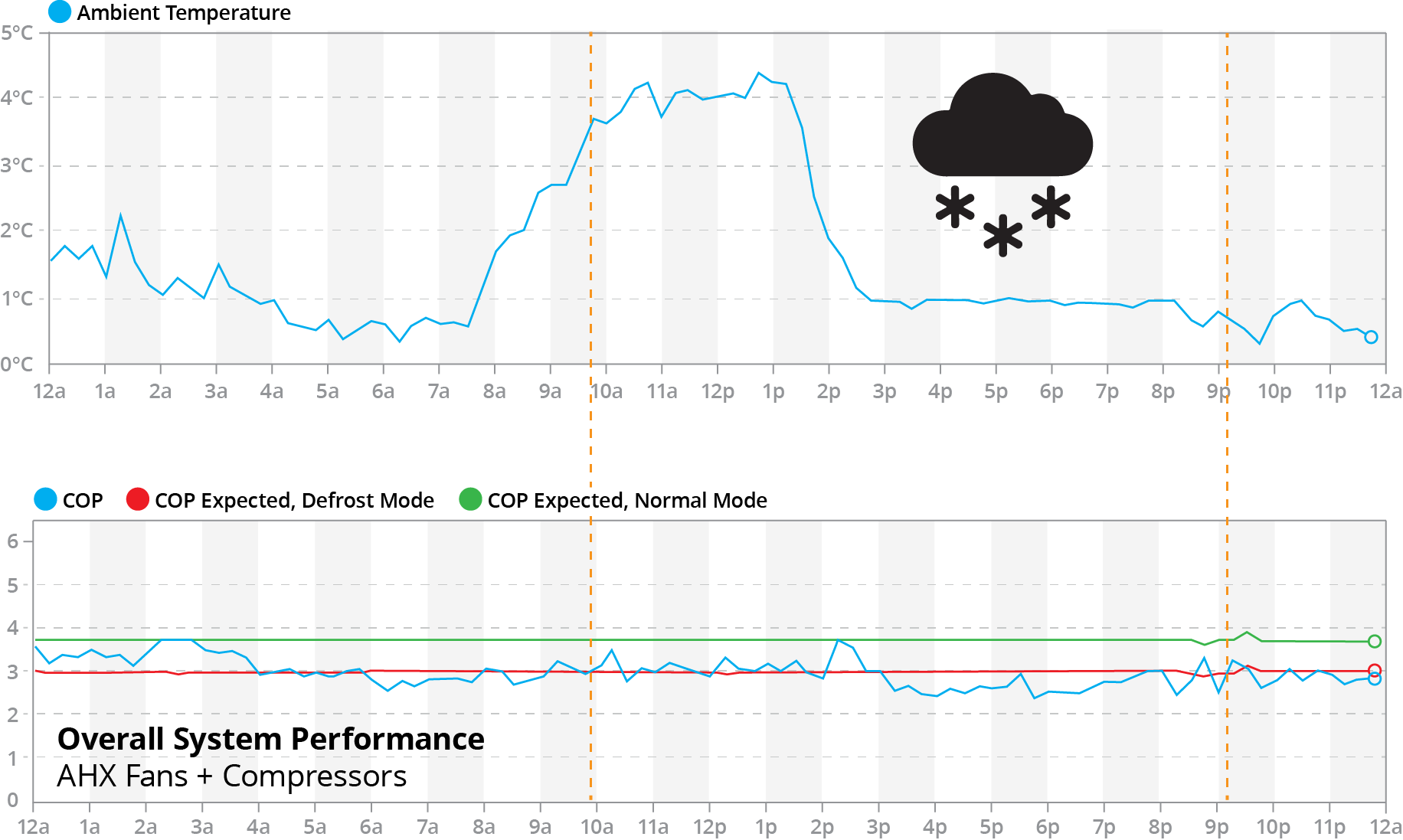
This figure illustrates the system performance on February 16, 2026, under relatively mild ambient conditions transitioning into a period of snowfall.
The upper chart shows that ambient temperatures remained above freezing and increased steadily through the morning, reaching approximately 4–5°C around midday before gradually decreasing in the afternoon and evening. Snowfall conditions are then observed from approximately 3:00 p.m. to 9:00 p.m.
The lower chart compares actual system performance (blue) with expected performance under normal operation (green) and defrost conditions (red).
During the morning and early afternoon, when ambient temperatures are higher and no snow is present, the system operates close to the expected normal performance curve, indicating minimal frost accumulation and efficient heat exchange.
As snowfall begins in the afternoon, the system performance gradually shifts toward the defrost performance curve. This indicates the onset of frost formation on the air heat exchangers and the activation of defrost cycles. Between approximately 3:00 p.m. and 9:00 p.m., the system operates predominantly near the defrost curve, reflecting sustained frost conditions and periodic defrost activity.
Despite the presence of snow and increased defrost activity, the system maintains stable operation and continues to deliver consistent heating performance. The results demonstrate the system's ability to adapt to changing environmental conditions and highlight the effectiveness of the control strategy in managing defrost while maintaining overall efficiency.
Snapshot #2: February 19, 2026
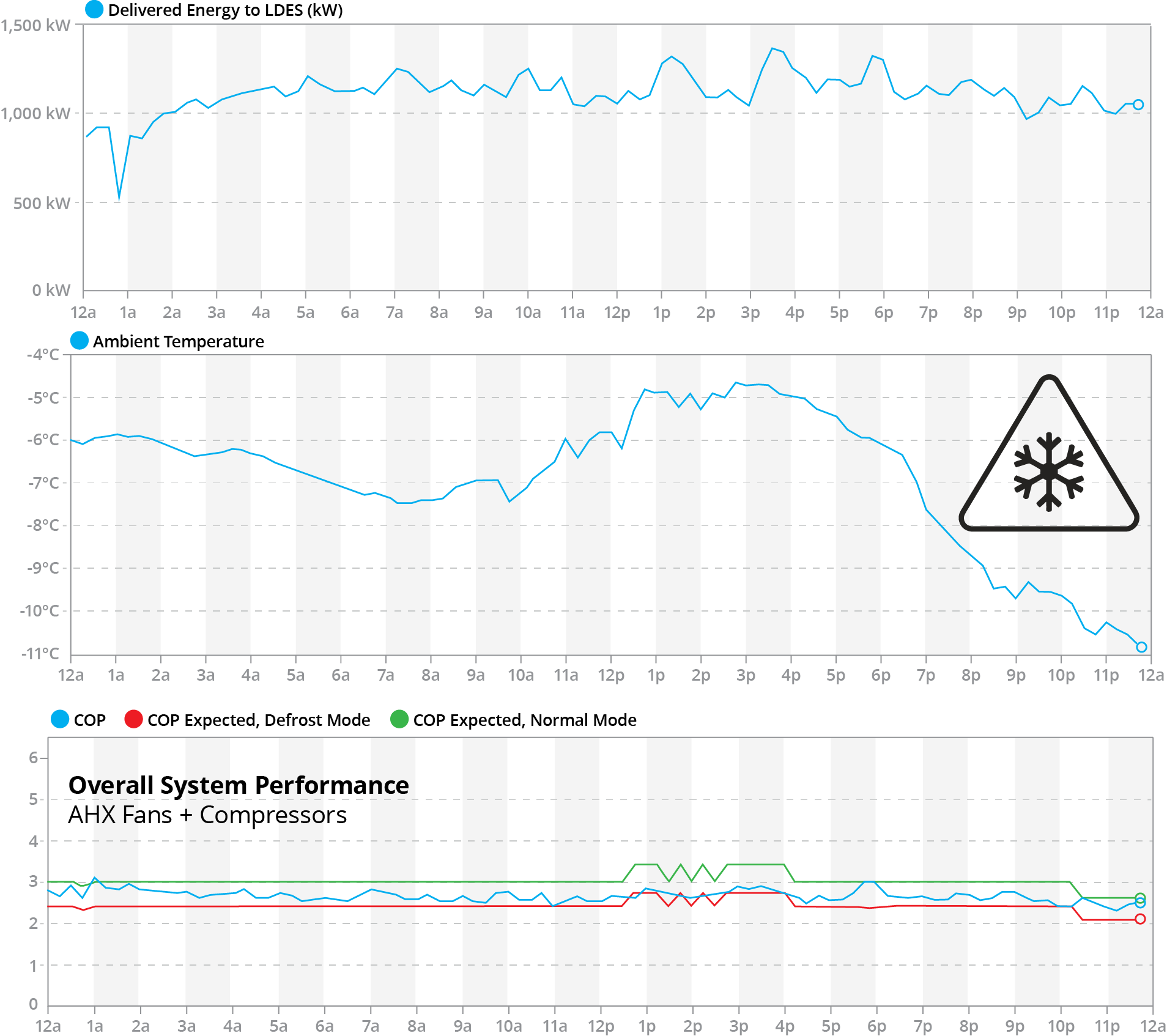
This figure presents system performance on February 19, 2026, under cold ambient conditions, with temperatures gradually decreasing throughout the day and reaching below -10°C in the evening.
Despite the low ambient temperatures, the system maintained stable and consistent thermal output, as shown in the top chart. The delivered heating capacity remained relatively steady throughout the day (> 1 MW), demonstrating the system's ability to reliably meet load demand under cold weather conditions.
The lower chart compares actual system performance (blue) with expected performance under normal operation (green) and during defrost conditions (red).
During periods of stable operation, the measured COP remains close to the normal performance curve, indicating efficient heat exchange. As ambient temperature decreases, the system increasingly operates closer to the defrost performance curve, reflecting the impact of frost formation and periodic defrost cycles.
Snapshot #3: March 14, 2026
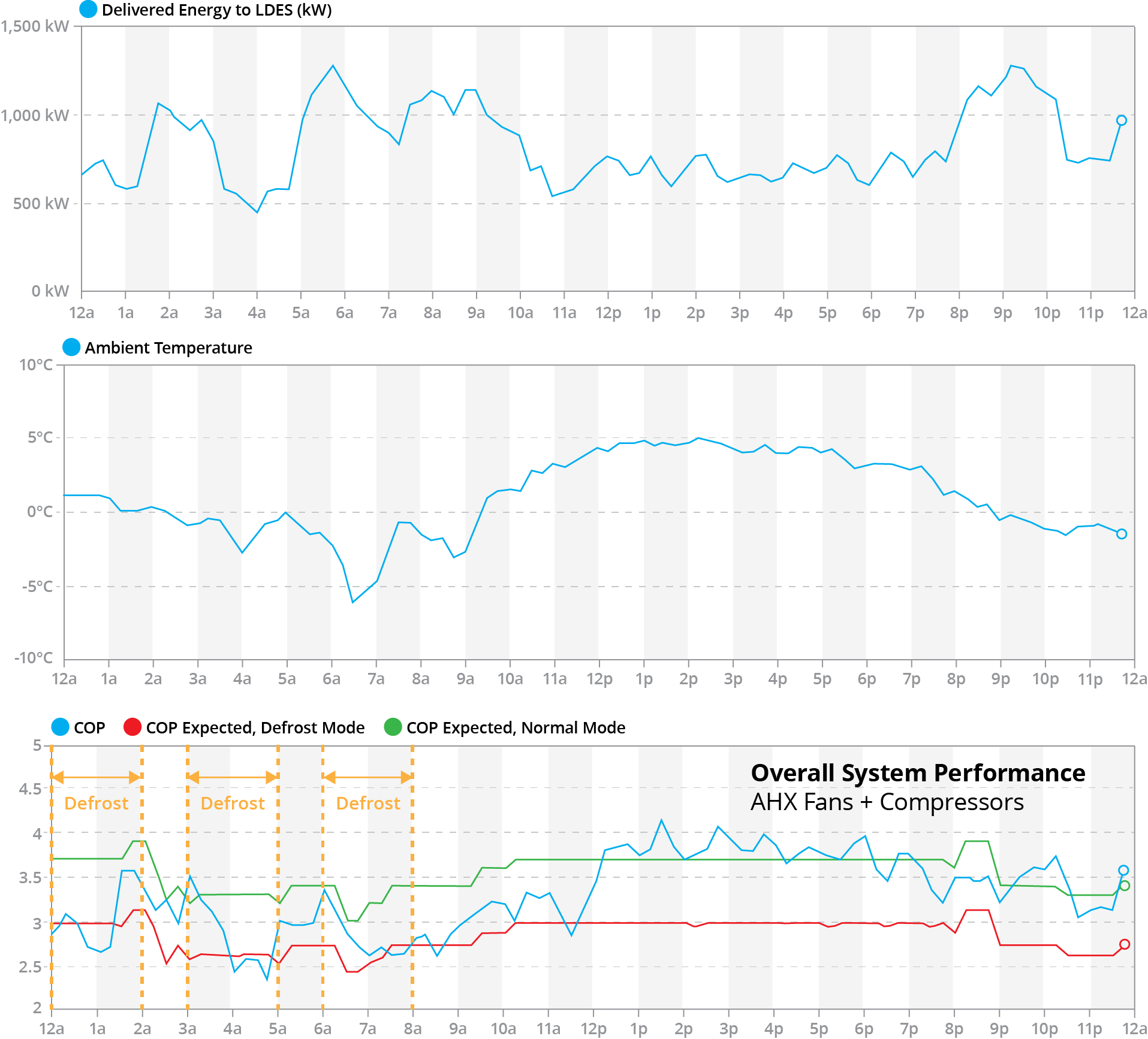
This figure illustrates system performance on March 14, 2026, under moderate and variable ambient conditions. Ambient temperature fluctuates between approximately -6°C in the early morning and up to 5°C during the afternoon, representing typical shoulder-season operation with changing thermal demand.
The top chart shows the delivered thermal energy to the district energy system, which varies throughout the day in response to load fluctuations. The system demonstrates strong responsiveness, adjusting output to match demand while maintaining stable operation.
The lower chart compares actual system performance (blue) with expected performance under normal operation (green) and during defrost conditions (red).
Several defrost events are observed during the early hours of operation, as indicated in the chart. During these periods, the system COP temporarily drops toward the defrost performance curve, reflecting the impact of defrost cycles on system efficiency.
Between defrost events, the system quickly recovers and operates closer to the expected normal performance curve, demonstrating effective control of frost accumulation and rapid return to efficient operation. As ambient temperatures increase throughout the day, defrost frequency decreases and overall system performance improves, with COP stabilizing closer to—and even higher than—predicted COP for normal operating conditions.
Overall, the system exhibits strong adaptability to changing ambient conditions and load requirements, maintaining reliable operation while efficiently managing intermittent defrost cycles. This highlights the effectiveness of the control strategy in balancing performance and reliability under dynamic operating conditions.
Lessons Learned
This project has provided valuable insights into the implementation of R744 heat pump systems in real operating environments.
Control strategy is critical: Small changes in control parameters can significantly impact system stability and efficiency.
Load profile matters: Smooth and realistic load requests are essential to avoid cycling and instability.
Defrost optimization is key: Proper sequencing and timing of defrost cycles have a significant impact on overall performance.
Commissioning under real conditions is essential: Iterative testing and tuning in actual operating conditions are necessary to fully optimize system behavior.
These lessons are being incorporated into future designs and control strategies to further improve system robustness and performance.